Retrograde amnesia
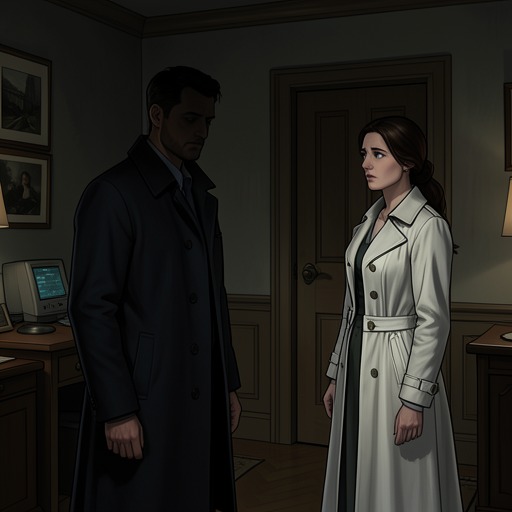
The Book of MirrorsRetrograde amnesia shapes Derek Simmons’s life after a head injury in psychiatric custody: he says he loses his personal past up to the injury but can remember what happens afterward and retain practical skills. The condition first leaves him unable to recognize people or his own identity; years later, recovered memories reopen the history of his marriage, Joseph Wieder’s care, and the murder investigation. In a novel preoccupied with how recollection is made and judged, his amnesia is at once a lived rupture and a problem of evidence: remembering vividly does not settle whether a memory is accurate, and being unable to remember can make a witness easy to dismiss.
The Condition and Its Boundaries
Derek describes his memory loss as retrograde amnesia, a break between an inaccessible personal past and the period after his head injury. When he comes out of a coma at Trenton Psychiatric Hospital, he recognizes no one and cannot remember even his own name. He is tested, and the doctors conclude that he is not feigning the condition. The injury has not, as he later explains it, erased everything he knows: it has disrupted memories tied to his identity, not practical abilities. He can repair a house without remembering when or how he learned to do so, just as he can ride a bicycle without recalling the experience of learning.
The distinction makes the condition more than a blank interval. Derek has to assemble his biography as if learning about another person: when and where that person was born, who his parents were, and which school he attended. At Marlboro Psychiatric Hospital, he gradually learns these facts, but finds the recovered outline painful. It includes his mother’s death, psychiatric hospitalization, a miserable job, an unfaithful wife, and an accusation of murder. Rather than continue to investigate that former self, he decides to start again after release. The effort offers a way forward, but it also leaves his identity dependent on information supplied by other people and institutions.
Care, Dependence, and a Life Rebuilt
Derek’s amnesia develops within a chain of custody and care. After his arrest for his wife’s murder, he is found not guilty by reason of insanity following an examination by Wieder and committed to Trenton Psychiatric Hospital. A patient’s attack there causes the injury and coma. After he recovers physically, Derek is transferred to Marlboro Psychiatric Hospital; Wieder’s assessments help secure both the transfer and, later, his release. When Derek has nowhere to go, Wieder finds him accommodation near his own house and employs him as a handyman. He pays him regularly, makes sure he takes his treatment, takes him fishing, and spends evenings with him. Derek comes to regard the professor as a friend and benefactor, and even a hypnosis session at the university seems, at the time, to belong to that caring relationship.
That trust changes meaning when Derek begins to recover his past. He checks the labels on the pills Wieder prescribed and asks a pharmacist about them; he is told they are for flu and indigestion, not amnesia. Derek concludes that the man he had taken for a protector had instead kept him close because he feared Derek might remember what happened. The novel presents this as Derek’s discovery and interpretation, not as a general medical account of the condition or an independently established explanation for his treatment. Its force comes from the reversal: the same practical help that made a life possible also gave Wieder proximity to a witness whose memories might return.
Memory’s Return and Its Triggers
In March 1987, Derek watches a NY1 report about a man from Bergen County who has died by suicide. He recognizes the man as Stan Marini, a former maintenance worker from Siemens, and recalls that Marini married around the same time as Derek and moved to New York. Derek understands the memory as significant because he believes nobody had told him about Marini’s death and he had not read about it. He describes the return as a buried lid lifting, with memories surfacing at tremendous speed. The news item does not simply tell him a new fact; it makes him aware that he can retrieve a connection from his own past without receiving it from someone else.
That opening gives way to memories of meeting Anne, the early happiness of their marriage, her infidelity, and Derek’s belief that she was involved with Wieder. He recalls the morning of her death, his conversation with Wieder, his arrest, and the ordeal in hospital. The recovered sequence changes his understanding of the professor: a relationship remembered as kindness becomes entangled with the fear that Wieder was monitoring what Derek might recover. Yet the return of an autobiographical sequence is not the same as outside verification of every detail in it. The story keeps that distinction alive as Derek’s recollections become testimony about the Wieder case.
Testimony Under Suspicion
Before his memories return, Derek tells an investigator that he knew who killed Wieder and that he had given the police the same account at the time. He says his statement was discounted because he had previously been accused of murder, confined in a psychiatric hospital, and treated with medication; he expects that a lawyer would have portrayed him as unreliable or delusional. The surviving case record establishes that Derek did not admit to killing Wieder and that he was found not guilty by reason of insanity in his wife’s case. It also documents his hospitalization, the injury that caused his amnesia, his later transfer to Marlboro, and his eventual release from supervision. These records establish the institutional history, but they do not by themselves resolve what Derek witnessed on the night Wieder died.
His account also conflicts with Frank Spoel’s. Derek places himself and Spoel hiding behind the house at about nine in the evening, yet says Spoel’s version leaves out Laura Baines and describes a different encounter between Richard Flynn and Wieder. When the investigator confronts him with these discrepancies, Derek suggests that Spoel may have forgotten or may be lying; the investigator, in turn, suspects Derek is not telling the truth. Earlier, an investigator had remembered Laura as having a strong alibi and regarded Derek’s statement as too compromised by his illness and amnesia to be useful. The competing accounts expose the double bind of the condition: Derek’s memory loss weakens his standing as a witness, but later memory cannot simply erase contradictions or guarantee that his recollection is correct.
A Wider Pattern of Unreliable Recall
Derek’s story sits within Wieder’s broader interest in how memories can be altered. Wieder explains that people may mistake a story heard in childhood for an event personally experienced; Richard Flynn, for instance, had believed he watched the 1970 Super Bowl as a child, although he was only four and had heard his father recount the game. Wieder also describes an experiment in which students who could not initially remember getting lost in a mall were given that suggestion under hypnosis. Three-quarters later described the supposed event, including their fear and being reunited with their mothers. The detail of their recollections made many resistant to the possibility that the episode had never happened.
These examples do not make Derek’s amnesia equivalent to a false memory, but they establish the novel’s caution about treating confidence, vividness, or missing recollection as simple measures of truth. His recovered past has personal and investigative consequences, while the people assessing it must distinguish experience from inference and memory from later information. The condition therefore functions both as a rupture in Derek’s identity and as a test of the systems that decide whose testimony counts. It restores a past Derek had tried to leave behind, without making that past—or the account of it—immune to doubt.